The community
Understand members, their needs, diversity, shared values, and ways of participating.
Lessons in growing our innovation systems.
A field guide to the people, programmes, partnerships, and everyday decisions that help African innovation communities grow.
50,000 TZS / 25 USD per copy
Order for delivery ↗Delivery available. Order by email to confirm payment, delivery charges, and timing.
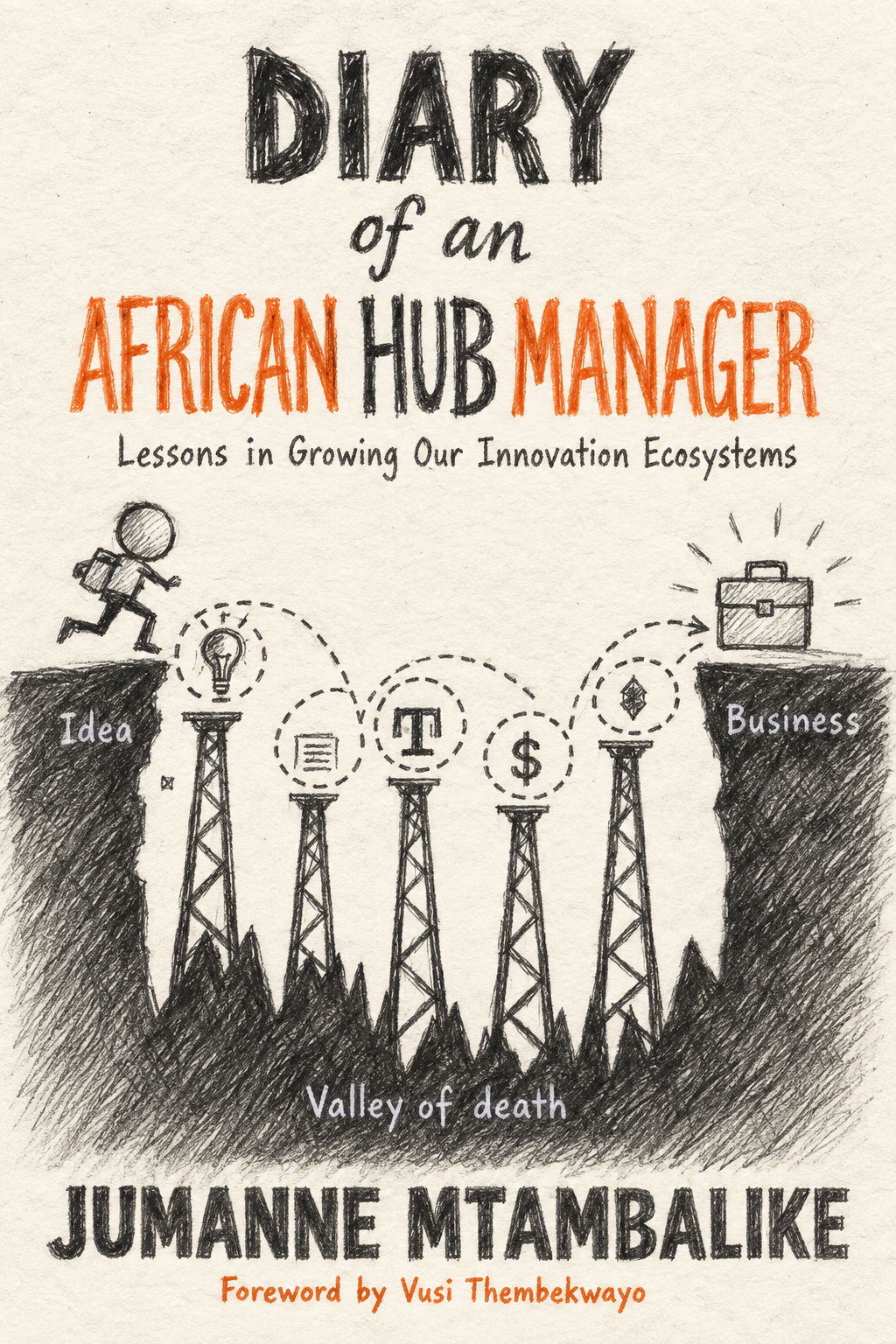
Drawing on his journey through KINU, Buni, and Sahara Ventures, Jumanne Mtambalike examines what it takes to nurture innovators and the institutions around them. The book is rooted in Tanzanian experience, with lessons and encounters from across the continent.
Written as a personal account rather than an academic study, it combines observations, cases, frameworks, and reflections. Its questions reach beyond hub managers to universities, policymakers, development partners, investors, and founders.
Preface · Chapter 1 · pp. 13–15
Eight themes connect the daily realities of hub management with the wider systems that innovators depend on.
A hub can be physical or virtual. Its strength comes from understanding its members, their expectations, and the relationships through which they learn. Shared values and regular conversations give the community a working culture.
Who belongs here, who is missing, and what do they actually need?
Chapter 3 · pp. 77–88
A hub manager connects founders, funders, public institutions, companies, and researchers. Business understanding, communication, and partnerships sit alongside daily operations. The community manager builds the close relationships that make support useful.
Can each partner explain the value of working with you in their own terms?
Chapter 2 · pp. 31–51
The book discusses Business Model, Lean, Social Business Model, and Value Proposition canvases. They make assumptions visible, but customer conversations and behaviour must test those assumptions. Enthusiasm for a product is different from willingness to use or pay for it.
What evidence would show that this problem matters to the intended user?
Chapter 2 · pp. 52–55
Events and bootcamps can help when they belong to a longer programme. The book challenges hubs to look beyond attendance and publicity toward outcomes such as revenue, follow-on financing, useful partnerships, or employability, depending on their mission.
What should participants be able to do afterwards that they cannot do now?
Chapter 3 · pp. 88–97
Grassroots and urban innovators work with different resources, institutions, and routes to support. The Innovation Support Ladder responds to these differences while connecting local activity to national and regional systems.
Which assumptions in our programme come from somewhere else?
Chapters 4–5 · pp. 114–119, 150–155
Hubs that imitate one another can crowd the entry stage while leaving later needs unmet. Mapping who supports each stage makes specialisation and referrals possible. A healthy ecosystem helps founders move between organisations.
Where should an entrepreneur go after our support ends?
Chapter 5 · pp. 178–185
The book argues for stronger links between grassroots innovators, universities, technical institutions, and research facilities. Existing knowledge and infrastructure can help improve products and connect learning to community needs.
Who outside our institution would benefit from its expertise or facilities?
Chapter 8 · pp. 272–275
Local ownership, a workable operating model, and a clear handover need attention from the start. Agile monitoring combines ongoing evidence with retrospectives so lessons can shape the next phase of an intervention.
Who will sustain this work, and what will we change when evidence challenges the plan?
Chapter 9 · pp. 290–301
The community informs the programmes. The programmes determine the team capabilities needed to deliver them. Each pillar depends on the others.
Understand members, their needs, diversity, shared values, and ways of participating.
Design relevant support with clear outcomes and continuity beyond individual events.
Build complementary capabilities, clear roles, partnerships, and reliable operations.
Chapter 3 · pp. 82–89, 106–107
The ladder maps levels of an ecosystem and their principal drivers. It helps shape support around local conditions and existing resources. These are connected contexts, not a ranking of people or ideas.
Chapter 5 · pp. 150–170
Start with local needs, local organisations, and accessible support.
Connect ventures, markets, hubs, and business partners.
Coordinate institutions, priorities, and enabling conditions.
Connect knowledge, opportunities, and support across borders.
The book's Innovation Ecosystem Canvas examines funders, government, academia, private companies, service providers, nonprofits, research institutions, development partners, and community culture. Ask what each contributes and where connections are missing.
Chapter 5 · pp. 174–177
Identify who handles five functions: identifying, registering, accelerating, promoting, and investing. Clarify mandates and handovers so support is coordinated and gaps can be addressed.
Chapter 5 · pp. 178–180
Match support to the venture's stage. A hub can specialise, then refer entrepreneurs to providers with the next capability they need. The goal is continuity from idea onward, rather than repeated entry-level activity.
Chapter 5 · pp. 182–185
Selected accounts from the book, presented in their historical context. They illustrate the author's lessons; they are not independent impact evaluations or updates on the organisations today.
The author describes moving beyond basic registration data to understand members' expectations, then holding bi-weekly discussions about their needs and frustrations. These conversations informed operations and helped members understand their responsibilities.
Combine member information with recurring conversations. Record what you change in response.
First-hand operational account · Chapter 3 · pp. 85–88
At a 2014 hackathon on market prices, developers were building apps when an invited farmer explained that his community listened to a radio programme for price information. The story exposes a solution chosen before the existing behaviour was understood.
Ask how people solve the problem today before choosing a technology.
First-hand workshop anecdote · Chapter 3 · p. 95
In the author's account of 2014 Dar es Salaam, Buni focused on foundation skills and networking while KINU, DTBI, and Mara Spaces offered other forms of support. Mapping those roles revealed opportunities to complement one another, although collaboration remained difficult.
Identify a gap you can serve and agree a practical referral with another provider.
First-hand ecosystem account · Chapter 5 · pp. 182–185
The book recounts STICLab's 2015 challenge win after months of support from Buni. At the time of writing, the author reports that its solar-powered water-purifying and vending machine had not reached the market. He uses the case to question what happens after competitions.
Plan the route from prototype to adoption, with a named owner and follow-on support.
Retrospective account; outcome reported in the book · Chapter 9 · p. 291
The author describes the 2017 UNFPA accelerator adopting an agile approach to monitoring and evaluation: gathering insights and holding retrospectives at each stage, with lessons informing the next phase.
Schedule learning reviews while there is still time to change the programme.
First-hand programme account · Chapter 9 · pp. 298–301
The author's encounter with Mr Ally at MAKISATU describes an informal maker who had already sold more than 200 stoves and exported some to Burundi. The case asks how technical and academic institutions could help with product improvement and access to markets.
Find practical innovators beyond formal incubators and identify the institutional support they need.
Author-reported encounter and sales figure · Chapter 8 · pp. 272–274
Four practical worksheets adapted for this page. Work on a real hub, programme, or partnership. Each exercise should lead to a concrete action and a review conversation.
Use the book as a working companion. Start with the challenge you face, select a relevant framework, and bring the people affected into the discussion.
Review the three pillars with your team. Choose one unmet member need and reshape a programme around it.
Start the three-pillar review ↗Bring providers together to map responsibilities, overlaps, and a missing handover in the support pipeline.
Map the partnership ↗Agree the outcome, evidence, and learning checkpoints before the next event or intervention begins.
Plan the evidence ↗Identify a community innovation to support and agree who will sustain the work after the pilot.
Plan beyond the pilot ↗Try a 45-minute team session: spend 10 minutes on a relevant case, 20 minutes filling one worksheet, and 15 minutes agreeing an owner, a next step, and a review date.
Suggested website exercise · Adapt to your team's context.
Read the full story, revisit the frameworks, and bring a practical question back to your team.
Based on the author-supplied January 14, 2023 PDF of Diary of an African Hub Manager: Lessons in Growing Our Innovation Systems. References use the book's printed page numbers. Cases are paraphrased historical accounts from the book, with their evidence type identified. The worksheets and meeting format are website adaptations, not reproductions of the original canvases or validated scoring instruments. The full manuscript is not hosted here.