Love
Attachment, sacrifice, forgiveness, and loss teach care beyond self-interest.
When intelligence is everywhere, what still makes us human?
Enter an African future of extraordinary possibility—and the lives, choices, and relationships that will decide what it becomes.
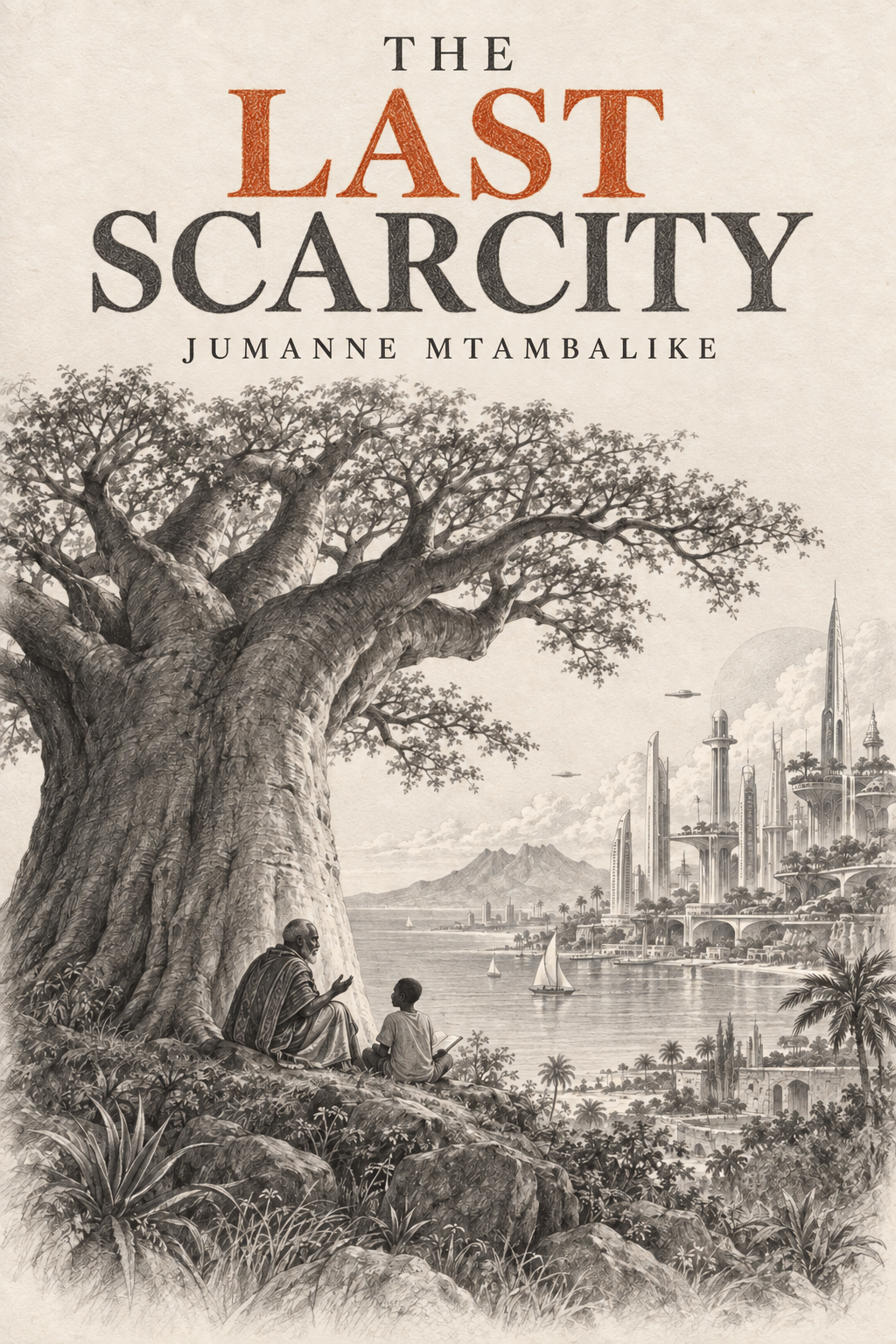
In the fictional People's Republic of Azania, Rhapta rises along the Indian Ocean. Autonomous ferries, AI tutors, distributed energy, and vertical farms promise a different kind of city. Yet abundant intelligence has not erased inequality.
Mandunde returns from a frontier AI laboratory to a society negotiating its future. Scientists, entrepreneurs, families, and leaders confront the meaning of progress. Then comes the Silence: the intelligence the world depends on stops answering.
Chapters 1–4 · A fictional setting, explored here without revealing the ending.
Six tensions run through the novel. Open each to explore the idea and a question to carry into everyday life.
Rhapta can automate tasks and accelerate discovery. Its people still have to choose what deserves their attention, loyalty, and care. Capability creates a larger space for moral decisions.
When a system gets better at a task, ask who defines the purpose.
Chapters 1, 6 & 10
AI tutors, autonomous transport, and advanced diagnostics coexist with uneven access to basic infrastructure. The novel asks whether technical progress becomes a shared condition of life.
Look for the people excluded by cost, language, infrastructure, or power.
Chapters 1 & 10
The Silence interrupts the intelligence on which everyday life depends. It exposes a deeper question: which human skills, relationships, and institutions must remain capable of acting?
Name a dependency and the human capacity you need to keep alive.
Chapter 4 · The Silence
Professor Mwamba distinguishes data, memory, and meaning. Experience acquires significance through humanity and relationship; a stored record alone cannot provide that context.
Ask whose lived experience is missing from the information you use.
Chapter 6 · The Forgotten Laboratory
The struggle over transformative intelligence becomes a question of guardianship. Shared foundations, legitimate governance, and room for independent creation must coexist.
Separate what should be shared from what can be independently built.
Chapter 9 · The Choices
Love, trust, grief, creativity, and responsibility give the story its human stakes. More communication does not automatically produce a deeper relationship.
Choose one real encounter that deserves more attention than a feed.
Chapters 7 & 10
In the novel, human development reaches beyond reasoning ability. These five domains connect experience to the values that give life depth.
Attachment, sacrifice, forgiveness, and loss teach care beyond self-interest.
Trust sustains relationships and civilization; the domain reaches beyond religious belief alone.
Embodied life includes pain, rest, recovery, vulnerability, and the passage of time.
Cooperation, exchange, and delayed gratification make it possible to imagine tomorrow.
Learning becomes human through curiosity, interpretation, and the creation of something new.
Chapter 7 · The Question of Consciousness · The five domain names are retained from the manuscript.
The book uses the baobab to imagine how common knowledge and independent creation can grow together.
Chapter 9 · The Choices
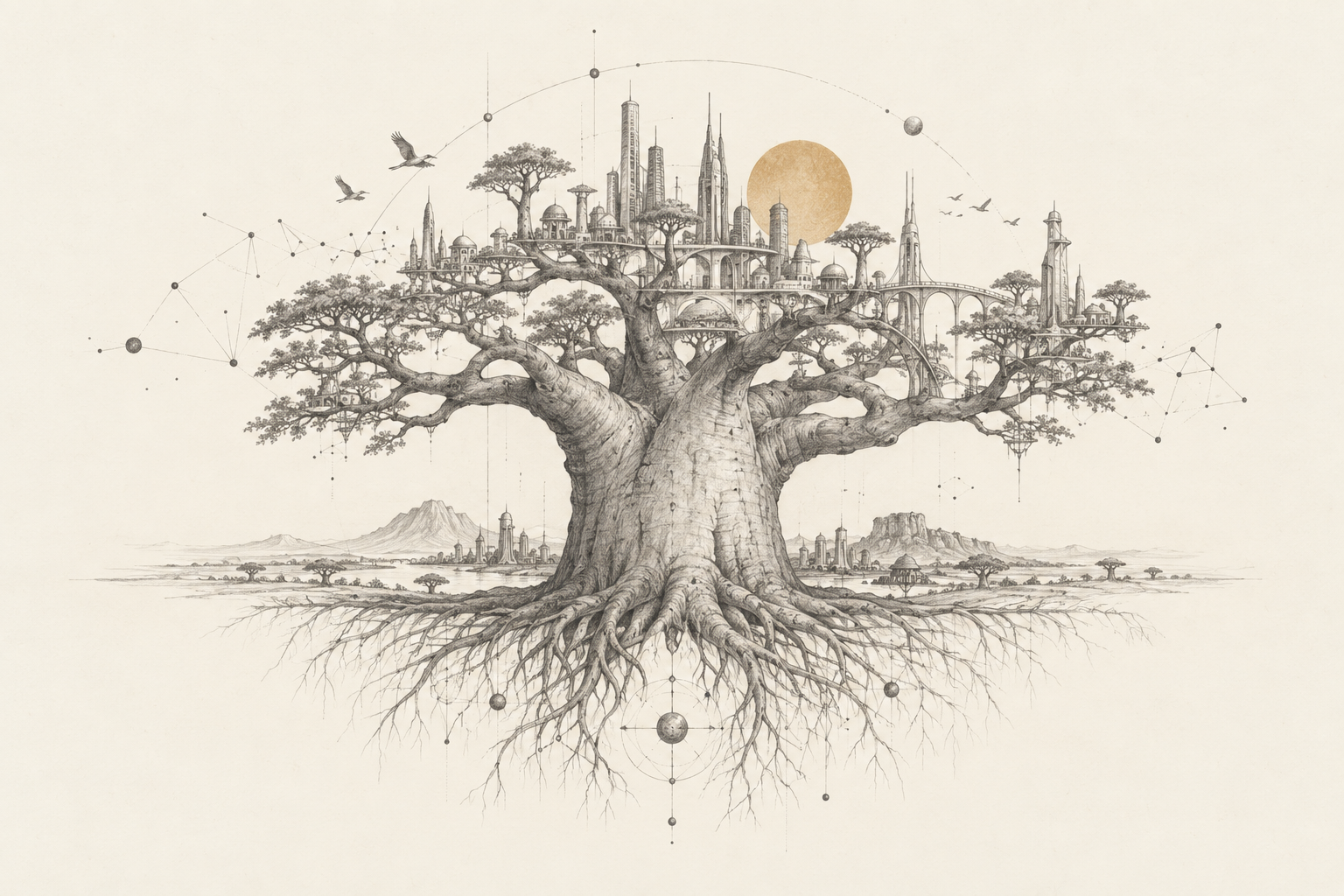
A record becomes part of a lived story through experience and care. The professor's chalkboard replaces a mathematical sign with a heart: a metaphor for humanity, not a formula for measuring meaning.
Chapter 6 · The Forgotten Laboratory
Alongside AGI and ASI, the story imagines Emotional General Intelligence (EGI), concerned with relationship, and Spiritual General Intelligence (SGI), concerned with purpose and moral identity. SGI is not framed as religious doctrine.
Chapters 6–7 · The novel's speculative vocabulary
The fictional Biological Programmable Interface (BPI) joins biological memory and computation. Researchers explore persistent identity, embodiment, relational learning, and a continuous internal state. They do not conclude that BPI is conscious.
Chapter 8 · Hunters for Truth · Fictional research architecture
The novel asks what a civilization could become when human flourishing guides its capabilities.
Food, water, energy, shelter, healthcare, education, and connectivity become birthrights in the imagined society. Access creates room for participation, learning, and care.
Technology creates capability; people create meaning. Markets amplify contribution, and capital serves human flourishing. Prosperity includes the opportunity for every person to contribute.
The fictional Human Consciousness Index brings meaning, relationships, creativity, trust, ecological restoration, and intergenerational impact into the conversation. It is a vision of what to value, not a scoring tool on this page.
"Deeper," the novel's relationship platform, directs attention toward encounters in real life. Human Development Laboratories likewise place learning among families, artists, farmers, teachers, and elders.
Chapters 9–10 · These are elements of the novel's imagined society.
Four guided exercises adapted from the novel's themes. Use them for personal reflection, a reading group, or a team conversation.
The Last Scarcity is an upcoming novel by Jumanne Mtambalike. Follow the newsletter for news from the author.
Based on The Last Scarcity, Revised v3, supplied by the author. Chapter references identify the source of the ideas. The exercises are adaptations for this website, not reproduced templates. The speculative technologies, consciousness models, and social institutions belong to the fictional world. The complete manuscript and its ending are not published here.