Think. Listen.
Connect. Create.
Critical thinking challenges assumptions. Communication brings out real needs. Collaboration brings different perspectives together. Creativity opens up alternatives.
Confusion to Clarity · pp. 66–69
An idea is a beginning. What you do with it changes everything.
A practical reflection on testing ideas, creating value, and building ventures that work in the real world—rooted in the experience of African founders.
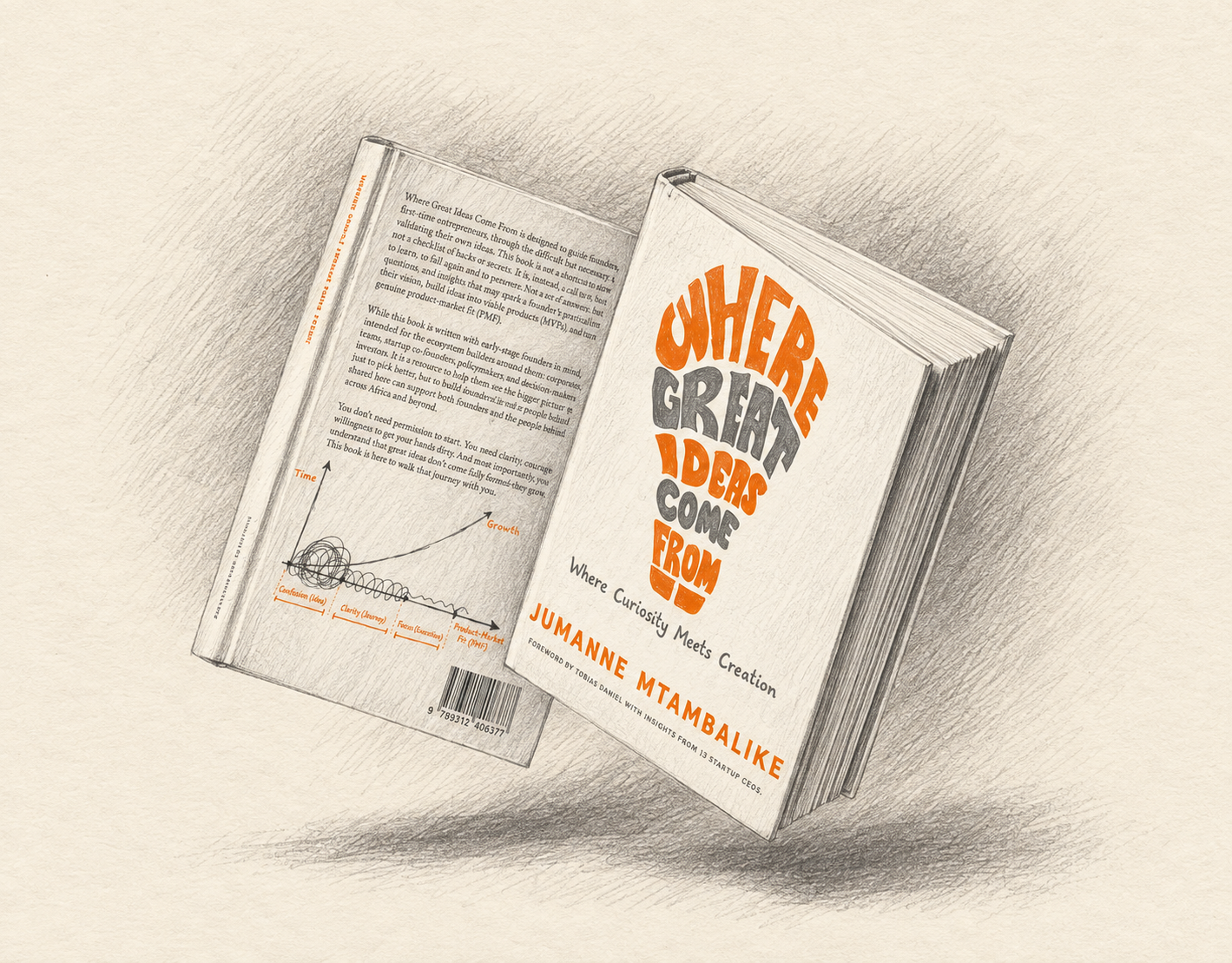
The book moves the founder's question from seeking approval to taking ownership of validation. Build something, expose it to reality, learn from the response, and refine it. The aim is a useful, sustainable venture—not simply a convincing pitch.
Written for first-time and early-stage founders, it also speaks to mentors, innovation teams, coaches, and ecosystem builders helping others move from possibility to practice.
Preface · Chapter 3 · Final reflection
Open a chapter to explore its central argument, the issue it challenges, and a practical action to try.
A useful idea can address an everyday desire, frustration, or need. It does not have to promise to change the world. Imagination becomes useful when it takes the form of a sketch, prototype, or conversation that someone else can respond to.
Chasing grand originality while overlooking ordinary needs.
Observe a recurring frustration. Sketch one possible response and put it in front of someone who experiences it.
Chapter 1 · pp. 4–11
A venture depends on the interaction of its idea, team, product, execution, and timing. A capable team can reshape a weak concept; a promising concept can stall when delivery or market readiness is missing.
Treating an impressive idea as a substitute for a capable team and a workable route to customers.
Name your weakest variable. Identify one decision that would strengthen it, and check whether customer behaviour supports your timing.
Chapter 2 · pp. 16–23
The book argues that an idea earns value through action. A rough prototype, a field conversation, or a simple landing page produces something that a polished but untested pitch cannot: a chance to learn from reality.
Waiting for permission, perfect conditions, or a flawless first version.
Choose the smallest useful version you can put in front of real users. Record what they actually do, then improve it.
Chapter 3 · pp. 28–35
Test desirability, feasibility, and viability together. Then look beyond the product: customers, regulators, investors, and partners all shape whether it can work. Context, repeatable processes, and resilience matter as much as the technology.
Importing a solution without accounting for local infrastructure, incentives, or stakeholders.
Write one assumption under each of the three lenses. Map the people whose cooperation you need and the constraints your design must accommodate.
Chapter 4 · pp. 42–49
Value comes from the pain you relieve or the gain you deliver, as the customer experiences it. Simplicity, access, and perception shape that value. A proposition must evolve as customers and markets change.
Adding features while making the core benefit harder to reach.
Describe the customer's desired outcome in one sentence. Walk through the journey to it and remove one unnecessary step.
Chapter 5 · pp. 54–61
Clarity emerges from interviews, prototypes, and evidence. Critical thinking, communication, collaboration, and creativity work together. Look for patterns in behaviour, including returning users and referrals, rather than relying on praise or isolated opinions.
Defending assumptions, listening only to vocal users, or mistaking activity for value.
Choose a belief to test. Observe a user trying a rough version, record where they struggle, and decide what evidence changes your next move.
Chapter 6 · pp. 66–73
Failure is useful when it creates learning without exhausting the resources needed to continue. Teams need room to question and experiment, alongside the discipline to review what happened and change direction.
Prolonging an unsuccessful approach to protect ego or past investment.
Set a time limit and resource limit for the next experiment. Afterward, name the lesson and decide what to change, stop, or test again.
Chapter 7 · pp. 80–87
The difficult middle between an idea and a sustainable business calls for skills, systems, knowledge, networks, exposure, and resilience. Founder well-being and the ability to filter conflicting advice are part of that capacity.
Confusing launch excitement with operational readiness, or treating exhaustion as progress.
Identify a missing capability, someone who can help, and a recovery habit you will protect. Turn each into a specific next action.
Chapter 8 · pp. 92–98
A product needs people who want it, the means to deliver it in context, and a viable business model. Strength in one lens cannot make up for ignoring the others.
The Systems · pp. 42–45
A conversation between all three.
Critical thinking challenges assumptions. Communication brings out real needs. Collaboration brings different perspectives together. Creativity opens up alternatives.
Confusion to Clarity · pp. 66–69
The book's diagram links customer response, regulatory compliance, investor alignment, and corporate collaboration. Map who can enable or block adoption—not just who might use the product.
The Systems · pp. 42–45
Keep an experiment short enough to change direction, affordable enough to continue, and clear enough to produce a lesson. The objective is learning, not failure for its own sake.
Embracing Failures · pp. 80–85
Four guided worksheets adapted from the book. Use them alone, with your team, or in a mentoring conversation. These are reflection tools, not a test of whether a startup will succeed.
The closing contributions bring the ideas back to lived experience. These are paraphrased takeaways from selected founder reflections in the book.
Small, imperfect action creates the feedback that shapes better ideas. Teams learn by acting, reflecting, and trying again.
CEO insights · pp. 118–119
Repeated friction and time spent with users reveal opportunities that strategy documents can miss. Ideas mature when assumptions meet reality.
CEO insights · pp. 122–123
A strong idea may be the mature version of an ordinary starting point. Execution exposes improvements that thinking alone cannot uncover.
CEO insights · pp. 140–141
Choose one assumption. Make one small test. Listen closely. Then let what you learn shape the next version.
This page summarizes Where Great Ideas Come From by Jumanne Mtambalike, using the supplied March 11 manuscript. References follow the book's printed page numbers. The worksheets and action prompts are web adaptations of its ideas, not reproduced templates or a predictive assessment. The complete manuscript is not hosted on this page.